ScatterPrism: convergence for generative simulation and inverse problems in particle and nuclear physics

Jul 2026·
Zeyu Xia
Zeyu Xia
,
Tyler Kim
,
Trevor Reed
,
Judy Fox
,
Geoffrey Fox
,
Adam Szczepaniak
Abstract
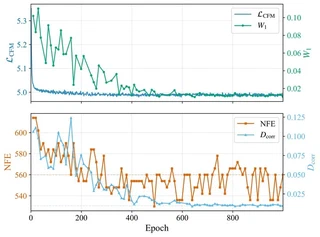
High-fidelity simulations and complex inverse problems, such as detector modeling and unfolding, are computationally intensive bottlenecks across subatomic physics, yet essential for accurate physical interpretation. While Conditional Flow Matching (CFM) offers a robust acceleration approach, we demonstrate its standard training loss is fundamentally misleading. Specifically, utilizing a Jefferson Lab Nuclear Physics (NP) kinematic dataset (\(\gamma p \to \rho^0 p \to \pi^+\pi^- p\)), we expose that CFM loss plateaus prematurely, obscuring ongoing physical refinement. To verify this disconnect is a dataset-agnostic pathology, we introduce ScatterPrism, an efficient generative surrogate evaluated against both the NP data and synthetic stress tests modeling challenging 1D distribution topologies. Coupling these benchmarks, we establish that physics-informed metrics continue improving long after standard loss converges. Consequently, we propose a multi-metric diagnostic protocol to ensure true kinematic fidelity without data memorization. Driven by NP challenges relevant to the forthcoming Electron-Ion Collider (EIC), this unified machinery has strong potential to extend to High-Energy Physics (HEP) applications, such as jet modeling. Furthermore, the framework holds promise for broader domains requiring rigorous generative reliability, including medical imaging, astrophysics, and quantitative finance.
Type
Publication
Journal of Instrumentation, 21(07), C07012. IOP Publishing
publications
Zeyu Xia
Authors
Zeyu Xia (he/him)
Computer Science PhD Student

I am a Computer Science PhD student at the University of Virginia, advised by Prof. Geoffrey C. Fox. I develop generative AI (GenAI) and scientific machine learning methods, with a focus on flow matching and GPU-accelerated differentiable simulation. My work connects efficient sampling, benchmark design, and model evaluation with inverse problems in the physical sciences. I contribute to DeepVELA, a Genesis Mission project exploring agentic benchmarks for scientific applications in collaboration with MLCommons. My work spans time, energy, space, cost, and precision evaluation and agent harness design with structured, verifiable outputs. I have also prototyped and trained JEPA world models.

I am seeking 2027 research internships in generative AI and ML systems. Get in touch.